On the Righteousness of God

Romans 4:9-12

Paul here, addressing the readers, poses a very important question. Having already proven that Abraham was accounted righteous in times preceding the Law, thereby showing that it was not the Law which imputed righteousness; here he asks rhetorically if this grace of God, this righteousness imputed by the Lord, was attained through works of circumcision, or if it is possible for one who is uncircumcised to also receive it. He then immediately answers his own question with another question.

I’ve often heard that the best way to present a valid point isn’t by asserting your own opinion, but rather to pose a question that could make one consider a topic from a different perspective. And this we see Paul do exactly here. “Can the uncircumcised who walk in faith be righteous?” was the initial question that he asks. In so doing, he affirms something that all reading would have acknowledged, that Abraham was considered righteous due to his faith, not some adherence to the Law which hadn’t yet been given. “Well, when he believed and it was accounted to him for righteousness, was he circumcised or uncircumcised?” he goes on to ask. Then, he answers this question by stating that Abraham was, in fact, uncircumcised when this righteousness was accounted to him. This is such a strong, valid point that he is here making to the believers as well as to the Jews who declared themselves righteous because they had Abraham as their father, because they had the Law, and because they were of the circumcision.

See, what Paul was explaining to them, more reminding them actually, was that the sign of circumcision was given to Abraham as a seal of the faith that he had been walking in already. The Jews, well educated in the Torah, would have recognized that Abraham was seventy-five years of age when he left Haram, thus beginning his walk of faith in the Lord (Genesis 12:4); and yet he was ninety-nine when he received the sign of the circumcision (Genesis 17:24). Thus, during that entire span of (at least) twenty-four years, he was righteous before God, even though he was uncircumcised.

This is so important because it shows that he was not made righteous through the circumcision, but rather through his faith, of which circumcision was merely a sign. Further, it shows him to be the father not merely of the Jews, but also of the uncircumcised believers (the Gentiles). As his circumcision made him the father of the Jews, so also his righteousness in the Lord before the circumcision made him the father of of the uncircumcised believers as well. As we learn from Isaac and Ishmael, it is not the children in the flesh who are the heirs; but the children according to the faith and the promise. If it were merely that the flesh produced heirs, then Ishmael would have been the primary heir, being the firstborn of the flesh. Rather, Isaac becomes the heir because it was he who was born of the promise. Remembering that the Jews proclaimed their righteousness based on the physical bloodline of the nation Israel running through their veins and the physical circumcision which they had received, it was such a strong notion for Paul to account that the things of the flesh were of no profit for the people, but rather the faith of the promise.

Then, Paul goes on to bring into account something that many wish to overlook. Remembering that the Jews had received the Law but were unable to keep it because they had not the faith, thus not the power of the Holy Spirit or the cleansing of the Lord to assist them to growth in holiness; Paul states “That righteousness may be imputed to them also.” What so many wish to overlook is this word, “imputed.” This word translates “reckoned” or “rendered.” This is not a mere legal standing, it is not a “ticket to the kingdom.” Rather, it shows that God’s righteousness is actually rendered to mankind; it is given to us. It is a righteousness that actually transforms us; both externally (as we see in the circumcision) and internally (as we see Paul multiple times reference the “circumcision of the heart). This transformation is the grace of God empowering us to attain the true righteousness of God. It is the power to obey and the knowledge of what to obey; all with the proper motivation, which is the glory of the Lord. Paul writes incessantly about “works,” both dead works (those whose motivation is vainglory and pride) and living works (those whose works are motivated by the love of the Lord).

Consider this, consider that Abraham was considered to have been righteous beginning at the age of seventy-five. Is that to say that he had no knowledge of the Lord or belief in the Lord prior to that point? By no means, but it was at that point that he, through faith, obeyed the Lord’s command to leave Haram. He may very well have acknowledged the Lord before that, but it wasn’t until he displayed that faith and trust in the Lord that he was considered righteous. Look at Paul’s life in itself. He describes this perfect life of trust when he shows what all he “suffered for the Lord’s name.” (Acts 9:16). It was through the grace of God that he was freed from his previous ignorance and wickedness, however, it was through his work for the kingdom that his true faith was displayed.

This concept is especially important in our generation. This righteousness that is rendered to us, this transformation, is both internal and external. So many who consider this righteousness, this grace, as merely a declaration, a label that we can wear externally, completely fall short and miss the point. It’s a cliche that I so often hear, and yet is fully true; God’s grace is given to us to free us from sin, not so we can freely sin. It is not given to us so that we can continue in our ways exempt from the repercussions of our sin, but rather so that we can free ourselves form that bondage and walk in righteousness. Our works will not warrant us this salvation, but if we are truly being saved, works will necessarily be manifest in our lives; however, for the right intentions, with the correct motivation. We will never boast in our philanthropy, however, that doesn’t mean that we don’t give. Rather, we give anonymously, never seeking our own glory. We give because we love our neighbor, because we love our brothers and sisters. We see each living person as an icon of Christ and at that point we are truly able to understand Jesus’ teaching that “whatever you do to the least of these, you do to Me.” If each person is truly an icon of Christ, if we fully love each person as Christ loves us, then we would never seek to judge, or to set up lines of division, but instead we would fully devote to help, to care for one another.

So often in Scripture, we are warned that God will “render to each according to their deeds.” And yet, so often we gloss over that. I’ve actually heard someone say that “thankfully God won’t give to each of us according to our deeds,” and yet Scripture warns that He will do exactly that. Scripture warns that if we don’t forgive, we won’t be forgiven; it warns that we should avoid avarice, lest we, like Ananias and Sapphira be stricken down in our lies; it warns how hard it is for the wealthy to enter the kingdom. It warns that whoever doesn’t care for the needy, the hungry, the poor will be “cast out into the lake of fire; in that place there will be weeping and gnashing of teeth.” But, to counter each of those warnings is the promise of the blessings to come if we abide in the Lord. If we love Him, trust in Him to provide (have faith in Him), if we abide in His commands; then “all things work for those who love God and seek Him;” and we know that “there is therefore now no condemnation for those which are in Christ Jesus, who walk not after the flesh, but after the Spirit.” (Romans 8:1). Once we turn in faith fully to the Lord, then we are empowered to cast off those fleshly urgings and longings and to truly walk in the Spirit, to allow the healing to begin. When Paul admonishes us that we should “constantly evaluate to see that we are walking in the faith” (2 Corinthians 13:5), this is such a huge part of it. If we are not growing in holiness, then what are we growing in? Are we growing in holiness, receiving the guidance of the Holy Spirit, walking in faith as “God’s co-workers” (1 Corinthians 3:9), or are we growing in worldliness, in the spirit of the age, in the wisdom of men and the ways of the flesh?

I pray that, for each of us, the answer to that question is the former, not the latter. Mark the Ascetic teaches us that when we read Holy Scripture, we should apply all that we read to ourselves, not to others. In so doing, consider this statement from Jesus; “You shall know them by their fruits.” (Matthew 7:16). So when we look to our own lives, what does the fruit that we are producing say about us? Are we being faithful? Are we loving our neighbor? Are we placing our wants over others’ needs? Are we forgiving others, regardless of their transgressions? Or, are we wearing the grace of God like a badge absolving us of any personal accountability? Are we content with proclaiming that “I’m not perfect, just forgiven?” Consider this; how many of our prayers extend beyond our own little “bubble,” our own circle of friends and acquaintances, and how many of our prayers become action? It’s so much easier to tell someone “I’ll pray for you” than to actually help them, to actually give, to actually sacrifice our time and energy to do what is necessary to help them. Yet, look at the model that we were given. Jesus didn’t just pray for us, He sacrificed Himself to save us. What are we willing to sacrifice to help one another? “Whosoever believes in Me will do the works that I do, and even greater works than these” (John 14:12). We must never believe that our works can save us, but we must equally never believe that works should not be a part of our salvation. The doctor can prescribe the medicine and tell us exactly what we need to do; we must be willing to get the medicine, to take it, to follow the healing that is prescribed to us. When Jesus told the rich young ruler to sell all that he had and give the money to the poor, have you ever considered why He commanded that? It was the first step in his healing, Jesus sought to help him overcome his greed, his attachment to material things. The ruler refused the treatment and went away sorrowful, still enchained to the world.

May the grace of the Lord be with you, my beloved family. Christ is in our midst.
On Sin and the Wall of Separation

I have often heard it said of sin that sin creates a wall of separation between us and God. And while this may be a truth conceptually, it evokes what can very easily become an extremely dangerous response in our faith. See, when we conceptualize sin as creating a wall between us and God, our first reaction is to go and pound on the wall, to try everything in our power to knock it down. We want to take down the wall to restore ourselves in God’s eyes. But, the danger with this is this; in doing this, we focus on the sin (the wall) rather than Jesus. It places us in the position of focusing all of our energies on sin itself, rather than on the great Physician who can actually cure us of the affliction, who can empower us to defeat sin.

See, the first danger that this creates is that it causes us to distill our faith to a list of dos and don’ts. It characterizes our faith in a manner that we begin to believe that we can obtain righteousness through adherence to this list of rules. Consider the Jews during Jesus’ earthly ministry. We become the equivalent of that. They were so lost in their studies of Scripture, in their knowledge of the Law and the rules, that when the Messiah Himself stood next to them, they argued with Him about what the Scriptures said. They actually argued the meaning of the words of God with God the Word, because they were so blinded by their “knowledge.” We become the equivalent to that when we begin to tear down this wall in that we are so busied with defeating the powers of sin in our lives, we manage to neglect the source of true righteousness.

But, there’s another very great danger that this can lead us into; albeit slightly more subtle. See, Satan loves nothing more than to see a Christian so caught up in self-loathing and self-inflicted guilt that they become blinded to the forgiveness that Jesus has given us. Because the other great danger that this leads us to is focusing on ourselves, relying on ourselves, and ultimately, worshiping our own willpower. This is blatantly characterized by the Christian who, when he slips and commits a sin, beats himself up about it, writhing in guilt and anguish, allowing despondency to overtake him because of his own lack of ability to defeat this sin. See, Paul addressed this in his letter to the Corinthians. He penned the words, “Godly sorrow produces repentance leading to salvation, not to be regretted; but the sorrow of the world produces death.” (2 Corinthians 7:10). When we sin, which we will inevitably do, we confess and repent of our sins, and then have faith that we are forgiven. Those who cause themselves to suffer this emotional and mental turmoil, sometimes even physical, are those who are not trusting in the power of the Lord to bring about healing, but rather, are trusting in their own ability to overcome these impulses that we all carry within us. No one wills to sin; the alcoholic doesn’t will to be an alcoholic, the short tempered man doesn’t will to have a short temper, no one wills to sin; but when we rely on our will alone, then we ultimately will sin. I’ve often said, and will constantly say, that if willpower alone were enough, the gyms would be just as busy on April 1st as they are on January 3rd.

When we focus on the sin, we empower it. We begin to focus on it rather than the Lord, and in doing so, we begin to trust in our own ability to overcome this sin, looking at sin as a list of dos and don’ts, rather than as a condition that exists within us that requires the healing hand of the Lord to overcome. We so often think of sins as individual actions, which sometimes it is; rather than as a condition, an illness, which it more often is. In Romans, Paul says “But sin, taking opportunity by the commandment, produced in me all manner of evil desire.” See, it’s not one action which he refers to as sin, but rather this condition which in turn produced “all manner of evil desire.” It’s much more of a condition than a simple action, though the actions are the fruits of that condition.

My brothers and sisters, when we find ourselves committing a sinful deed, we must not focus on the sin itself, neither the actions which were produced by it. Rather, we must fully focus on the Healer, the great Comforter, the Physician who can heal us of this illness. Only through our full faith in Jesus will we ever be able to defeat the power that we have ultimately allowed sin to have in our life. Through study, we can learn what sin is and what it’s fruits are; and through prayer and meditation, through repentance and confession, we can focus our attention on the One who has the power to heal us of that affliction. May we always remember that, and focus our attention of “things that are above, not the things of the earth.”

May the peace of the Lord be with you, my beloved brethern.

On the Importance of Relationship vs Knowledge

Romans 4:4-8

Paul here accentuates the fact of the loathsome theology that he had previously redressed, the theology that states that we are made righteous through works of the Law. He explains to the this concept: to believe that our works of the flesh hold any bearing on our standing with the Lord, that we could earn our righteousness in anyway, would in fact place us in a position of having the Lord and Creator of all things as our debtor. To explain, when I work at my job, I create a debtor/debtee relationship. I work, thus my employer owes me payment for services rendered. My employer, at that moment, is indebted to me. When I receive my paycheck, it is his repaying the debt which I am owed. This is the exact mindset that Paul is approaching here theologically. If we perform works for the purpose of obtaining the grace of the Lord, then our works create a debt situation, and His grace becomes the payment that is given to repay that debt. Thus, in considering this, we create the exact situation of the Lord, the Creator, being indebted to us, rather than the truth, which is the inverse. So often, we like to consider that the Lord needs us; as though we are doing Him a favor when we go to Church. How often do we enter the mindset of “I’ll go to Church/tithe/spend time in prayer, so long as…” We create this sort of spiritual quid pro quo with the Lord in our minds, but what we fail to understand is that God doesn’t need us; we need Him. 100 years ago, I wasn’t here; and 100 years from now, I shall not be here; but His work will still be done. He doesn’t need me, but I desperately need Him. And, when we are able to remember that, then suddenly the things like spiritual disciplines cease to be a chore, but rather become what they truly are, a gift. Abiding in the commandments of the Lord cease to be work and become a privilege; when we consider that it is only through His power that we are able to abide in those commandments. We no longer practice wickedness, not because we feel as though we will earn entrance to the kingdom because we stop, but rather because we are given the freedom and the power through the Lord to break free of those chains.

Our salvation is no sort of paycheck received in exchange for our “working towards the kingdom,” and neither are our works some sort of divine spiritual blackmail. Our faith is not in the works that we perform, but rather in the One who enables us to perform them. And that for His glory, not for ours. Consider how greatly the Lord is glorified when an adulterer is not merely forgiven for his sins, but is actually freed from their power over him. Or the drunkard who is not merely forgiven for his intoxication, but is actually convicted and empowered to be freed from it. Chrysostom, in his homily on the Gospel of Matthew, states, in explaining the term “good tidings” (translated “Gospel” in contemporary times), “…for it was for the removal of punishment, and remission of sins, and righteousness and sanctification, and redemption, and adoption, and an inheritance of Heaven, and a relationship unto the Son of God, which he came declaring unto all…” Acknowledging that the Lord is able to free us from this bondage is the first step of doing so, and the actions and suffering which accompany these actions, this freedom, are an extension thereof. Paul is stating that it is because of faith that we are saved, and that our salvation necessarily entails this adherence to the commands of the Lord; but that obedience to the commands of the Lord in absentia of faith are nothing more than legalistic moralism. And acknowledgement of His ability to free us in absentia of the work that is required is nothing more than lip service; it is the man who constantly tells his wife that he loves her, but never buys her flowers, or takes her out, or gives her flowers for their anniversary. It is the man who says I love you but is unwilling to change anything that offends her; that claims to love one woman but still craves the intimacy of others. When we become joined to someone in wedlock, we acknowledge that there must be change because of that commitment, likewise, when we turn to the Lord in faith, there must also be changes that accompany that. A man could never get married just because he quits going to the bar; however, a man who is married to a woman who doesn’t like him going to the bar will eventually stop going or cease being married.

This is where we find the disconnect that Paul is addressing here. Take, as an example, a man given to short-temperedness. He knows from the Scripture that the Lord considers unjust anger a sin. Thus, he goes out of his way to control his temper. That man, by the sheer will of his mind, able to obtain some degree of control over his anger, is not saved by his ability to keep that temper in check. However, if he were to turn to the Lord in true faith, as part of his salvation, his healing, that lack of control would be solved. However, because the healing comes from the Lord, it wouldn’t be a conscious decision to control his temper, rather, his heart would change to where situations which previously invoked his anger no longer do so. Similarly, a drunkard cannot obtain the kingdom of heaven through sobriety, however, through faith and spiritual maturity, he would necessarily become sober, if he is truly walking in the faith. It becomes a part of his healing. Drinking alcohol is not a sin in and of itself, however, drunkenness is; thus for the average person, partaking of the vine is perfectly acceptable in moderation, however, for the alcoholic, it is not. Thus, the healing that each of us is empowered to by the Lord varies depending on each person. This is a very fine, but necessary, line, for each of us to remember, and a large part of the reason that it is so dangerous to judge the actions of another. The remedy for the illness of sin which afflicts me will be different from the remedy which the Lord gives to you; thus to judge you based on what the Lord has given to me becomes a very dangerous slope, and one which Jesus Himself warns us against.

Paul continues, evoking David as his witness, that this theology of faith versus the Law, not only predated the Law (v. 3-4) but was also visible during the time of the Law. See, it’s easy to look to Abraham and Noah and state that they were made righteous through faith before the Law; and just as easy to state that once the Law was given, that it took precedence over the faith that those patriarchs were given. Thus, Paul shows that this theology of faith over the Law was evident during the time of the Law as well. As we discover in Psalm 31, David discovered what had already been given to Abraham to know; our forgiveness comes through the grace of the Lord, through repentance, through humility, and through faith. The purpose, nay the very power of the Law, was never to provide us with a means to righteousness, but rather to reveal to us sin that we could repent, in faith, and understand our need for healing and for guidance. My conscious willfulness could never obtain to perfection, to the “righteousness of God,” but through my knowledge of the Law, I can recognize my sinfulness, which I can then turn in the stillness of prayer and faithfully ask the Lord to guide me into His righteousness.

We must always be mindful of the fact that the Law, nay all of Scripture, was given to us for a purpose. And that purpose was so that we could better understand the need for our faith and for the grace of the Lord to guide us into righteousness, to free us from the bondage of iniquity. In much the same way as the Law was for the Jews whom Paul is addressing, is imperative for our faith. But, similarly, Scripture, like the Law, is not our faith. Our faith is our relationship with our beloved Christ, and Scripture is the means by which we can come to know what is and isn’t pleasing to Him. It is the means by which we can learn what is pleasing to Him and what is displeasing. But, knowledge of Scripture is by no means a sufficient substitute for our relationship with our Lord Jesus. I believe that, especially in our time, far too little time is spent in reading the Holy Scriptures. But, I believe that even more forsaken is our time spent in communion with our beloved Lord; time spent in prayer. I’ve met many people who have committed themselves to reading 10 chapters of Scripture per day, and yet spend only five to ten minutes in prayer.

To relate this concept in more concrete, more contemporary terms; I am married. Imagine, if you can, a world in which I have one hour to spend with her in a day. Now, imagine if during that hour I spend 55 minutes of it reading her diary and only five minutes actually speaking to her. Jesus has promised us that He is always with us, yet how much time do we spend actually communing with Him? Take any great figure, any celebrity; historical or contemporary. Now, imagine that you read their biography. Imagine that you have read Babe Ruth’s biography. Or JFK’s biography. Would you proclaim, in the face of critics, that you had a relationship with him? Would you say that he is your friend? Of course not, because reading about him and actually knowing him are two totally different things? And yet, we do the exact opposite with the Lord. We read Scripture and proclaim that it is our relationship with Him. And the more we know, the closer we feel that we are. And this is the mindset that Paul is warning against with the Jews. They knew the Law forwards and backwards, in multiple languages. They could take one letter of the Aramiac text and explain everything about it, from it’s origins to speculating whatever meaning they thought could be derived from it. But, when He actually walked the earth, when they were given the opportunity to know Him, they were so lost in their textbook theology approach, that they refused to actually know Him.

We need to be extremely careful of doing the same thing. In our generation, it so often happens that we replace intimacy with connection; that we mistake maturity for wisdom. We constantly consider our acquaintances to be our close personal friends. And, we apply this to everyone, to extended family, to friends that we’ve never met, to anyone and everyone. And ultimately we’ve done this with the Lord Himself. We read, we do Bible studies, we learn everything that we can about Him; His likes, His dislikes, His rules, His commands. But, so often, we do that and mistake that for growing in our relationship with Him. We mistake our knowledge about Him for our spiritual maturity. But, we must remember that we can never “exegete” our way to a relationship with anyone, much less with God. Knowing and obeying His Law won’t save us, but if we are growing in our relationship with Him then we will obey His Law. It’s ever so important to understand His words, but it’s equally important to remember that our relationship with Him is so much more than hermeneutics and memorization. Memorizing Scripture is not maturity, and theological science is not salvation. Salvation is the love of God reconciling us to Himself, and making us to walk in His steps, being remade in His image. There’s much more to our faith than our studies, rather, it’s the love of God made manifest through us, displayed to the world, and all to the glory of God.

I pray that none of us lose sight of this. By no means would I ever say neglect reading the Scriptures, they truly are imperative to our faith. At the same time, however, may we never mistake our knowledge of Scripture for true spiritual maturity. And, even moreso, we must never neglect our communion with our Lord, or with His Body, which is the Church.

May the peace of the Lord be with you all, my beloved family. Christ is in our midst.

On Patriotism and Immigration

So many times in our generation, I see and hear about this labeling, this banner-mark, of “Christian, Republican, and Proud.” It’s this complete mindset that directly links our faith with, not merely political ideologies, but rather to a direct political party. It’s this thinking that ties our theology to our political affiliation and suddenly, once we give into this mindset, our doctrines begin changing based on secular worldviews. Ultimately, it’s this very mindset that creates one of the biggest idols in all of Church history, patriotism. It creates a theology that looks very much like the “American dream,” one where the feeding of the hungry and the poor takes a back seat to lining the pockets of corrupt politicians and their corporate lobbyists. It replaces the tabernacle with the media and substitutes the priest for the anchorman. As things seem to become more and more bleak, we find ourselves ultimately turning to our savior and his apostles, the president and congress, for the answers to the things that ail the nation. We look to the government for our basic needs, as well as providing for others; relying solely on the compassion of the government to help those in need, thereby freeing ourselves of our God-ordained calling to compassion and love. We place our faith in elected officials rather than in the One who is truly capable of effecting our salvation and we pledge allegiance to a geographical location rather than the supernatural Body of Christ. The very people who go to Church on Sunday but consider their faith to be a “private, personal” matter will gladly stand anywhere screaming how they are “proud to be an American.”

Before I go any further, I would like to state this; firstly, I am in no way attempting to target or demonize America as a whole; I am sure that you could find a similar mindset in other nations, however, being from America, I feel as though I would have no ability to offer an opinion on any other nation. Secondly, this is in no way an endorsement nor indictment of any particular political party. I am not stating that the Republican or Democrat party is right or wrong, rather I am warning about the dangers of elevating either of those parties to the level that we all too often do. Jesus warned of this very thing when He commanded us to “render to Caesar that which is Caesar’s and to God that which is God’s.” Finally, I ask of anyone who reads this, read it with an open mind, an open Bible, and read it to it’s completion before you either affirm or deny any of what is written herein. I know that, especially when broaching the topic of secular political conversation, it is very easy for one’s convictions to impede on one’s ability to see things from any other viewpoint. Before I began my study of Scripture, a lot of my opinions on topics was very different than they are now, having done many studies; and I expect many more will change before I fall asleep in the Lord. While I normally avoid any politically charged topics in my studies, a situation occurred recently which convicted me to study and write my findings on these topics. Between my recent exegetical breakdown of the Book of Romans and this situation that I will expound on momentarily, I just had to do more research on the topic.

I recently read a quote, one which I personally felt the highest degree of reverence for. It was concerning the topics of abortion and immigration. The quote was “What does it mean to be pro-life if you protect the life of a child inside the womb, but not the life of the child on the border.” I loved the contrast in the statement, because, unlike the comparison of abortion and capital punishment, the life of a child on the border is innocent. Regardless of opinions concerning the death penalty, the fact remains that anyone on “death row” has committed a heinous act, thus the argument could be made that their just recompense could be death. The life of a six year old child fleeing persecution in his native country, however, creates a completely different circumstance, in terms of the contrast here. And thus, when I shared this quote with some friends of mine, I was aghast at some of the responses that I got; not from unbelievers, mind you, but from those who claim the title Christian. Those who bore the name of our Lord Jesus. I was taken aback because, all through the Scripture, we see this idea that every human being is an icon of our beloved Lord and to shut the door on those in need is to deny Christ, as He Himself taught us. “Whatever you do for the least of these, you have done to Me.” (Matthew 25:40).

As I read these multiple responses to this quote, they all shared one common thread, secular patriotism. And, even moreso, secular patriotism that superseded Biblical command. See, I deigned to do a study on the topic after reading these Christians responding to this quote about the value of human life, and found (to very little surprise) that all through Scripture, from Genesis to Revelation, nearly every book of Scripture mentions this idea of immigration. We see it in the form of figures from Scripture who were sojourners themselves. We see Abram fleeing to Egypt to live as a sojourner to escape from famine (Genesis 12); we see Lot fleeing from Sodom to Zoar to live as an immigrant there; we see Joseph’s brothers being welcomed into the land of Egypt (Genesis 47). In Exodus, we see Israel fleeing from Egypt to enter a land not theirs to live as refugees (Exodus 12). In fact, one command given directly to Moses by the Lord is “You shall neither mistreat a stranger or oppress him.” (Exodus 22:20). In Zechariah, we read a similar warning of the Lord, “Do not oppress the widow, the orphan, or the foreigner, or the poor” (Zechariah 7:8). The Lord commands us through Ezekiel that “the resident aliens who dwell among you and have sons in your midst…shall be as native born…and they shall eat with you in the inheritance.” (Ezekiel 47:22).

Given even these few examples, and there are many many more, it was enough to make me question how anyone who could ever presume to claim the name of Christ could gaze into the face of a six year old refugee seeking sanctuary from violence, hunger, and oppression, and deny them help.

And then, one response sort of resonated to me. It rang in my ears like the trumpets of war, echoing throughout the empty hearts of so many. The statement was this: “it focuses on the premise that we can solve all humanitarian issues by allowing everyone into the U.S. There are more than 65 million refugees in the world.” That rang a bell to me because it truly displayed the real issue. It would complicate our way of life, disrupting the entitlement that we, as Americans, have grown infatuated with. Much like the Jews that Paul is addressing in the Book of Romans, it becomes a matter of nationalism; as though only those born in a specific geography or to a particular lineage have the right to receive this salvation, this healing. In this instance, instead of spiritually, physically. That only those privileged to be born in a particular locale deserved the right to live free of oppression, free from violence, free from hunger and disease.

When we attach our theology to a political party, we are no longer abiding in the words of the faith, but rather in the party that slightly resembles that faith. Mainstream Christians look at an issue like abortion and say “this side supports abortion,” thus the other side must be the Christian side, regardless of how that party responds to other Biblically imperative issues; and eventually, they adopt all that that party represents. Suddenly, the party that opposes abortion but supports involuntary repatriation, the party that supports the death penalty, the party that supports gambling and alcoholism, the party that denies aid to starving families, becomes the “Christian party” that everyone aligns themselves with. Eventually, you end up with an entire Church whose philosophy is, “we love our God, and we love our guns.” As outlandish as it sounds, consider that there were churches in America where the pastors were encouraged to carry guns to protect their congregations.

So, how did we ever allow this to happen? The real issue at hand is that, as so often happens, we read the words of Scripture, we even affirm them; but we don’t live them out. And that’s the side effect of attaching our theology to our political views and parties. Our geographic patriotism supersedes the very words of Jesus and the apostles. Our faith is true in theory, but not in practice. In theory, we read Paul writing that “there is neither Jew nor Greek…but all are one in Christ.” (Galatians 3:28). We read Peter’s teaching that “you are a holy nation…who were not a people, but now are the people of God.” (1 Peter 2:9-10). See, we read these statements, we nod our heads, we scream our amens and claim to believe; and then we hear that the president wants to put up a wall to keep out immigrants and we begin to cheer; claiming that there’s no room for anyone else. Basically, in saying that, we are saying that no one born outside of our physical nation is worthy to be here. We claim to be “pro-life” because it looks good on social media, but in reality we’re pro-life while a child is in the womb, but once they are born, they’re on their own. I see this all the time in our culture. We demand that a child be allowed to live, but once they are born, we do little to nothing to help them, we complain about paying into social security, we complain about increased taxes to fund federal programs for relief, claiming that it’s not the government’s job; but then, we pass by homeless people offering little to no help on our own either. We become little better than the rich man who, when his fields yielded a greater yield, tore down his barn to build bigger barns to store the grain, rather than distributing that grain to the poor. And, when we do those very things, we prove by our deeds that we’re not pro-life, we’re just anti-abortion. We can check that nice safe little “Conservative Christian” box at the polls, or on the “Pew Research” survey, and then go back to the disconnect of not having to actually deal with any of those people whose lives we have destroyed. We look the family of refugees in the face, as they have worked and bled to get to a nation that offers the promise of opportunity, and tell them that they must go back to wherever they came from because we’re not comfortable with them here.

And, because of this disconnect, somewhere along the lines, we’ve forgotten, or consciously chosen to neglect, what our Lord told Moses; “You shall not oppress a resident alien, because you were resident aliens in the land of Egypt.” (Exodus 22:9). We’ve bought into this lie that the geographic location of our birth has somehow granted us this elite opportunity that we should actually have the right to deny others. Even worse, that the geography of our birth actually dictates our nationality. Again, we read the words of Peter, who proclaims that we are “sojourners and pilgrims in this world,” (1 Peter 2:11). Paul teaches us in his letter to the Ephesians that “at that time you were without Christ…having no hope and without God in the world…now…you are no longer strangers and foreigners, but fellow citizens with the saints and members of the household of God.” (Ephesians 2:11,19). In Hebrews, we are reminded that “here we have no continuing city, but we seek the one to come.” (Hebrews 13:14). And when we hear these words, in theory, we agree with them, we acknowledge them; but do we truly live that way? Do we truly live as a holy nation set apart by God, regardless of our geographical background? Or do we cling to our despotic, patriotic nationalism? Do we truly love our neighbor as ourselves, or are we so concerned with asking who our neighbor is that we forget to love them, to help them? Do we see in each person, each suffering, hungry, persecuted refugee, our Lord in Whose image they were made? Or do we deny them the help, the love, the hope that they need? We must strive to remember the teachings of our beloved Lord, who exhorts us, “Whatever you have done for the least of these, you have done to Me.”

I’ve got many dear brothers and sisters, from a multitude of geographic locations. And we are all one nation, truly, under Christ Jesus our Lord. I am neither democrat or republican, neither conservative or liberal, rather I am a disciple of our Lord Jesus and look into His Holy Scripture for the answers to all things, whether they be “secular” or “spiritual.” I am not an American and then a Christian; rather, I am a Christian who happens to have been born in America. And I pray, my beloved family, that neither I nor any of you would ever lose sight of that fact. Our kingdom is not in this world, this world is not our home, and I pray we never be so comfortable clinging to these government labels that we allow our lives to become otherwise. We were one nation, one people; and through our pride the Lord separated us when we built a tower attempting to reach up to the heavens. Then, on the day of Pentecost, He reunited His people, overcoming cultural and linguistic boundaries. I pray that through pride and patriotism, we would not recreate the very boundaries and divisiveness that He gave us the ability to overcome. Allow us to practice our faith, not merely theorize it. Let us value all life, both in the womb and out of it: the poor, the hungry, the widow, the orphan, the prisoner, the alien; and “let us not forget to show hospitality to strangers, for in so doing, some have entertained angels unawares.” (Hebrews 13:1-2).

May the grace of the Lord be with you all, my beloved brethern. Christ is in our midst.

The Garden

As a weed growing in the garden, so too is sin in our lives. Much like a weed, if sin is given nourishment, it will continue to grow and to spread until eventually the garden of our soul is overrun by it. However, if we deprive it of the necessary nourishment, it will slowly wither away and die. When we see the temptation to sin before us, we must make the decision whether we shall feed it or deprive it.

On Walking in Faith

Romans 4:1-3

Paul here, still defending the Gospel against the Jews, seeks to show, using he whom the Jews consider the great patriarch, that the Law is of no profit in absentia of faith, and that through faith are we made righteous and not through works of the Law. The Jews, who claimed that they alone were righteous, and that through their lineage, being descendants of Abraham and therefore given the Law were shown by the apostle that the Law had no power unto righteousness. Not only did the Law have no power unto righteousness, but neither did their very lineage. Paul’s proclamation here would fly in the face of the very Jews who rejected that salvation was the necessary response to faith; thus faith was the necessary foundation of salvation.

Abraham, the patriarch of the Jews, was righteous in the sight of God. Neither Jew nor Gentile could deny that fact. Thus, the question posed becomes, by what means was he righteous? See, this becomes so important in Paul’s dealings with the Jews because at the one, they proclaimed righteousness for the sake of the fact of being the seed of Abraham, and at the second, the receivers of the Law. Thus, to them, it was due to their lineage and reception of the Law that they were made righteous. Rather than challenge this notion, Paul addresses it a different way; if adherence to the Law alone were the foundation of righteousness, then those claiming such would be declaring Abraham himself unrighteous, as the Law had not yet been given in the time of Abraham. There was the demand for obedience, which always has and always will be the reciprocal side of the Covenant, whether Old or New; but the Law itself had not come into existence during the time of Abraham. Thus to declare that only adherence to the Law could make one righteous would be the declaration of the unrighteousness of all who came before the Law, including Abraham.

However, if our righteousness is through Faith, then; all who believe can be made righteous through their faith, as was Abraham; and thus obedience is to the Lord, not the Law. It was not Abraham’s works or obedience that made him righteous, but rather his faith, displayed (as we see numerous times) by his works. It was not his leaving of his native land that created in him righteousness, but rather his faith and obedience to the One who commanded it. It was not his willingness to sacrifice Isaac, but his faith that the Lord would provide a more fitting sacrifice. His works, while a necessary display of true faith, were not the foundation of righteousness, but rather the fruits of it. We see the same with Noah, who was not saved because he randomly built an ark in the middle of the desert, but rather, who received revelation from the Lord and, because of his faith, believed that revelation; and thus was given the means prescribed unto salvation. Had he no faith, then he would never have received the revelation, neither acted on it. Our salvation is neither faith alone, nor works alone, but rather it is faith sufficient to lead us to work in cooperation with the Lord; it is faith which provides the medicine and works which cause us to take it (to refer back to the idea of salvation as treatment for a sickness).

If our righteousness is works, teaches the apostle, then it is not a gift to be received, but rather our just reward. I go to work every morning, my boss owes me a paycheck. That isn’t grace, it is “payment for services rendered.” To use Paul’s terminology, it is a debt. I work for someone, they owe me for the work, creating a debtor relationship; and their repayment is according to the amount of work that I’ve done. One could often boast that they’ve worked harder, dedicated more time, etc. If, on the other hand, my payment is not based on my merits, but only on the grace of my benefactor, then I have no room to boast. Jesus alludes to this in the parable of the workers (Matthew 20:1-16). A man hires a worker in the beginning of the day for a set amount, and then one at the end of the day for the same amount. The former, at the end of the day grows envious of the latter, and the man states, “did I not pay you what we agreed on? Why are you angry with getting what you agreed to?” Each man was offered an amount, and each agreed to the reward for their services, but no man had any right to boast because their payment was not based on their work, but on what the man offered to them to begin with. Each man still had to do their fair share of work, but neither had the right to boast and neither had the right to argue, because each knew that regardless of their work, their reward would be the same.

Put another way, when it is through my own work that I obtain something, then I can boast in my own ability to receive it. But, when a man boasts about a gift that he has received, it is not in his own ability that he is boasting, but in the graciousness of the giver. This is precisely why Paul was such a great image of the grace of the Lord; being the most sinful of sinners previously, he became the greatest icon for the grace of the Lord. And though his salvation required many sacrifices and labors, it was all in the name of the Lord, and all to bring glory to His name. Paul could never have become the man that he became through his own willpower; and yet it still required the conscious decision to follow the Lord; it required the willful decision to go from town to town teaching the Gospel. Paul had much work to do, but it was not the foundation of his salvation to do that work, but rather as a result of it. As he “worked out his salvation,” he was constantly being led to do more and more work as evidence of that salvation.

This is the image of our salvation. In the same way as you can never earn a spouse, but through action or lack of effort you can lose him/her; so it is with our relationship with God. You can never “earn” a marriage, you can never “earn” a relationship; but through your actions you can either grow in your relationship or you can sacrifice it on the altar of self. Likewise, you can never earn you salvation, you can never earn your reconciliation with God, but once you have turned to Him, you can likewise turn away from Him. We see this in virtually every book of the Old Testament. And when we turn to faithlessness, when we turn away from Him, then we are no longer “walking in the faith.” We are seeking our fulfillment elsewhere, the world, other people, ourselves; we are “walking in our own ways,” seeking after sinful indulgences rather than seeking after the kingdom.

Our faith is a relationship; well is it so often compared to a marriage through the Holy Scripture. Works will earn us neither spouse nor salvation, as they have no power to either. However, much as consideration to wedding vows will help us to overcome earthly temptation, so too will salvation empower us to overcome spiritual temptation. In the same manner, however, we must be willing to abide in those vows, whether nuptial or spiritual, and do whatever work is deigned necessary to obediently follow them. No, adherence to the Law will not save us, neither will any physical bloodline be the source of our righteousness. Salvation is the gift offered to any, of any lineage; and adherence to the Law will never spawn righteousness, however, righteousness spawned from true faith will necessarily spawn adherence to the Law. And the test is relatively easy; if the Laws are, to you, an encumbrance to be dreaded, then it is not in faith that you are adhering to them. In faith, the Laws of the Lord will be a blessing to be celebrated, understanding that they are given to us of the Lord for the sake of our own righteousness, for our continually growing communion with Him. He will never give us a command that He Himself will not empower us, through His grace, to attain. However, to receive that, we must always walk in the faith, knowing and believing that He will, in fact, empower us.

May the grace of the Lord be with you, my beloved family.

On Redemption and the Ongoing State of Righteousness

Romans 3:23-26

Having established the degree of self-righteousness amongst the Jews who would have been present in the reading of this epistle, Paul once again removes from them this self-appointed mantle of righteousness. “It makes no difference, for all have sinned,” exhorts the beloved apostle. Note what he does not say. He does not say that all were born sinful, neither that all have a sinful nature, but rather merely that all have sinned. Each of us, though formed in the womb by the Lord, in His likeness, have sinned. Having received the Law in our hearts, we have made the conscious decision to turn away from Him and to give in to sin.

This is such a scathing statement against the Jews, who considered themselves to be above all other nations and people, who considered themselves beloved and favored of the Lord. Paul, here we see, “levels the field” against them. And so that they could neither elevate the righteousness that they had attained, nor elevate the sins of the Gentiles, Paul adds that not only have all sinned, but that all have sinned, and because of that sin, all have fallen short the glory of God. See, even in being exposed as sinners, it would still be possible for the Jews to downplay their sins and to elevate the sins of the Gentiles. You can almost hear them proclaiming, “yes, I’ve sinned, but my sin was far more forgivable than his sin.” Paul wanted to remove that mindset before it had even been able to be formed within. This glory of God to which Paul refers is eternal righteousness and eternal life. And what Paul effectively says here is that a Gentile’s sin falls short of that glory; a Scythian’s sin falls short of that glory; a barbarian’s sin falls short of that glory; a Jew’s sin falls short of that glory. James teaches us that all sin is equally sinful (James 2:11). Thus, if all men have committed a sin, regardless of what that sin is, then all men are sinners; thus all men being equally sinful, all men are therefore equally in need of the grace of the Lord, even the Jews.

Paul goes on to speak of us being “justified freely by His grace.” This word justification is an ongoing state of righteousness, not a one time “not guilty” verdict, as is often thought. The word he uses here, “dikaioo,” literally translates “to render righteous.” See, so often, when we consider salvation, we think of it as a one-time, once for all, card stamped, ticket purchased event. Salvation, however, as Paul images here, is instead this freedom that we could not attain to without the grace of the Lord. And that is what was missing from the Jew’s mentality. Through the grace of the Lord, through faith in the Lord, we are enabled to turn away from the slavery to sin in which so many of us are trapped. The Jews sought to do so through the works of the Law, which relying on their own willpower to obey the Law, would never have happened. The Law itself didn’t have the power or the purpose of freeing us from sin, merely to call our knowledge to it and to give us the means to make amends for it once we committed it. The power of the grace of the Lord, however, gives us the ability to actually turn away from it. That’s why I get so offended when I hear someone who claims to be a believer say that they have no power over their sin; they are declaring that their own lustful urges are more powerful than the One that they claim to be the Lord of their life. Rather, when we turn away from those things in faith, trusting in the Holy Spirit to free us from that bondage, then we are enabled through the Holy Spirit and the grace that is of the Lord to become truly freed from our bondage. When you turn away from the world, away from the flesh, and choose instead to walk with Him in faith, then you are able to overcome that weakness, to attain to the “righteousness of God.” Our faith in Him and love for Him produce the obedience that only He can offer us, the obedience that overcomes the longings of the world. But that obedience does require much work, and much sacrifice, on our behalf. It requires being willing to suffer for Him name, and to surrender those things which we innately love. That is why Peter teaches us that “whoever suffers in the flesh has ceased from sin.” This is why the Lord tells us that “whoever seeks to gain his life will lose it, but whoever loses his life for My sake will find it.”

And this justification requires redemption, which is a term that I feel is used more often than it is understood. We consider the term “redeemer,” the term “redemption,” as these easy things. Much like many things in our faith, we hear the word so often that it often loses it’s meaning. We think of the crucifixion in terms of the pretty paintings and the kids movies; and then a movie like “The Passion” comes out and we can’t watch it because “it’s too graphic.” But, in much the same way, we think of the word redemption and we think of it as someone sitting down at a table making a deal. This word hearkens back, however, to the blood offerings, the sin offerings, of the Old Testament. This redemption requires that a sacrifice be offered in our stead, and offering that could free us not only from sin, but from death. The Old Testament demanded that the offering be unblemished, spotless, pure. That was the sin offering of Jesus, which could free us from the power of sin. It was this perfect sacrifice that could not only atone for our sins, but could also bring us into eternal righteousness and life. Through the sacrifice of the only sinless, perfect sacrifice, Jesus freed us from the power of sin through His perfect life; and through the resurrection, freeing us from the power of death itself. Trampling down death with death, that those who abide in Him no longer shall die.

And, why did the Lord do all of these things? Why offer redemption to any of us, much less to all who would come to Him in faith? Paul explains it beautifully here. The Lord offers this gift of freedom, this gift of salvation, so that His righteousness, His justice, His fairness, could be demonstrated. See, if God had chosen only an elect few to grant this salvation to while predestining all others to perish in iniquity, then He would be proclaimed, rightly so, neither just nor righteous. Likewise, if He determined that all would be saved and live regardless of their faith, neither would He be just. There must be punishment and reward for their to be justice. No, His righteousness is displayed perfectly in that no one receives any partiality; but rather, all are offered the same opportunity, the same grace, the same freedom, and the same will to choose whether they will receive it or reject it. That is the just God, the righteous God. The One who offers the same chance to each person equally and then, based on their own free decision, they receive either grace or condemnation. But, they know in advance what the outcome of their choice is.

Our ongoing faith in Jesus is the only way that we receive the righteousness of God. Justification is not a one time decision, it is a way of life. It is the decision that we make every day, every moment, of our lives to walk with Him in faith. It is Christ living in us and we in Him. To be justified is to be in communion with Him in an ongoing, dynamic, growing life with Him. And the offer of that life is equally available to all; regardless of ethnicity, nationality, background, previous life experiences, financial background, occupation; any other labels of “qualification” that we could imagine to put on it. Each of us have sinned equally, for the One who created any part of the Law created all of the Law, and to disobey any part of the Law is to disobey the creator of the Law. Each of us have sinned equally and each of us is able to receive the offer of salvation equally. It, my brothers and sisters, is up to us if we choose to accept, or to reject, this offer to walk with Him.

May the grace of the Lord be with you all, my beloved family.

On the Purpose of Scripture

When we look unto Scripture, there are many things that we read contained therein, many commandments which the Lord Himself has given unto us. We learn those things which He loves and those things which He despises; we learn the things that can bring restoration of our relationship with Him, and those things which can separate us further from Him. Ultimately, we read about the things of holiness, the heavenly mysteries of our faith, and from them we are able to discern what is right and proper concerning the things that are of the Lord.

This ability that we have been given to learn these things, to glean this wisdom from the words of our Lord and God is a great blessing, however, if we aren’t careful, it can very easily become, through it’s misuse, a great curse, bringing upon ourselves great condemnation.

Allow me to explain. There’s a very vicious trend in all of our culture. We all want to “look good,” and the easiest way to do this, as any junior high kid can tell you, is to make other people look bad. And this is especially dangerous when considering Scripture, because Scripture is, in fact, the inspired words of God, given to us for the purpose of attaining to the righteousness and holiness of God; thus we so often use it as a guideline when we judge other people. We see a same sex couple holding hands in public and immediately begin quoting Leviticus at them; we see someone intoxicated and begin to evoke the words of Peter who admonished us to remain “sober-minded,” or Paul in his warning that “neither drunkards shall inherit the kingdom.” The list goes on and on; and none of those statements is incorrect. However, there is one simple fact that so many of us have missed.

The purpose of our reception of the Scriptures wasn’t to condemn the world, it was to sanctify believers. In his letter to the Thessalonians, Paul writes, “for this is God’s will for your life, your sanctification.” (1 Thessalonians 4:3). See how erroneous it is for us, who are called to attain to the righteousness of God, to apply those same standards to those who have rejected God, and then ignore those same standards ourselves. Consider when we see a homeless man standing on the street with a sign seeking alms, and our minds run to “…if any would not work, neither should he eat.” (2 Thessalonians 3:10). Oh how easy it is to use a verse like that to justify turning a blind eye to the plight of our neighbor; forsaking the Lord’s command to “love your neighbor as yourself” and His teaching at the end of the parable of the Good Samaritan; “‘So which of these three do you think was neighbor to him who fell among the thieves?’ And he said, ‘He who showed mercy on him.’ Then Jesus said to him, ‘Go and do likewise.'” (Luke 10:36-37). No, rather, the purpose for which the Lord gave us those words of Paul was not to judge the homeless man, but rather to teach us that we must work; we must never be a burden upon the culture, since we are merely visitors in this world.

See, there’s this trend that seems to run viciously rampant throughout our generation of reading the Scripture with one eye, while searching the crowds with the other to find those who are in violation of it. For example, when Jesus proclaims that “it is hard for a rich man to enter the kingdom of heaven,” we immediately begin considering who we consider rich. We adopt this relativistic mentality towards what it means to be rich, and consider ourselves not to be. Thus, we read that statement and say that it’s hard for a movie star to enter the kingdom, or that it’s hard for the president to enter the kingdom, because they’re rich. But we never consider ourselves to be rich. We drive past a homeless person on the way home from work and never consider that passage to be referring to us, because that would mean that we are rich, and we refuse to include ourselves in that category; usually out of some false sense of humility. But, consider this; on one hand is a homeless man, penniless and hungry, cold and wet, walking anywhere that they can go; on the other hand, we’re leaving work, driving in a car to a nice air conditioned house to eat a meal of whatever we want. We probably throw away each day more than that man eats in a day. But we’re not rich.

I could use so many examples of this, but I’ll leave it at those, because they serve the purpose at hand. See, when we read Scripture, when we read these warnings and admonishments, these commandments; the worst thing in the world that we can do is inflict them on others, that’s not what they were given to us for. They were given to us for our own sanctification, not as a guideline to judge others. St Mark the Ascetic teaches us that “A humble man who lives a spiritual life, when he reads the Holy Scriptures, will relate all things to himself and not to others.” When he states that, he’s not talking about the promise of blessings to come, he’s talking about the commandments that we are to adhere to. To use the words given to us in Holy Scripture as the means to judge others is to miss the point of the words of Holy Scripture. Paul says that “all of Scripture is profitable for doctrine, for reproof, for correction, for instruction in righteousness, that the man of God may be perfect, thoroughly furnished unto all good works.” (2 Timothy 3:16-17). Thus, the purpose of Scripture, according to Paul, is for rebuke, for correction, and for instruction in righteousness, don’t miss this, for the man of God. It wasn’t given for us to judge the world with, it was given to us for our own correction, for our own healing, for our own sanctification.

So often, so many of us want to use the words of Scripture to judge the world for being the world. Once more, I yield to Paul, who states, “I wrote to you not to keep company with the sexually immoral, yet I certainly did not mean the sexually immoral people of the world, or with the covetous, or extortioners, or idolators, since then you would have to go out of the world…for what have I to do with judging those who are outside (the Church)? Do you not judge those who are inside? Those who are outside, God judges.” (1 Corinthians 5:9-13).

It becomes a vicious cycle wherein we read a passage of Scripture, we gaze around, we see those outside of the Church violating the words of Scripture, we challenge that violation. We see the same sex couple and immediately begin to condemn them; we see the homeless man and immediately begin to judge him, imagining what he had done so wrong to deserve that. We see the man in love with his pornography and begin to judge him based on that, ignoring our own transgressions. We read Scripture and determine how it relates to everyone but ourselves, when the purpose for which we have received it is the exact opposite. When we see the homeless man, instead of remembering the story of Lazarus and the rich man, and relating ourselves to the rich man; we focus on the sins that led him to his circumstances, never noting that Scripture doesn’t tell us anything about Lazarus aside from his circumstances, and it never tells us anything about the rich man other than that he neglected the plight of his neighbor. Mother Teresa stated that “if you judge people, then you don’t have time to love them.” I love that quote, because it’s so true. If we begin to judge people based on other things, then we don’t take the time or have the sincerity of heart necessary to help them in their needs.

When we read Holy Scripture, my brothers and sisters, we must always remember to read it as the words of God, but as though He Himself were speaking these words to us. Rather than focusing on the sins of others, we should be focused on our own personal walk of faith, our own personal holiness. Our own relationship with the Lord. If each you and I were sick, and each of us went to the doctor; there is a strong possibility that the medicine that doctor prescribes me will be different than the medicine that he prescribes you. So too with salvation, the words of the great Physician may be different for your healing than for mine. We must always remember that and, rather than taking the time to judge or speculate what has led a person to a particular thing, instead love them and pray that the grace of the Lord would lead them into the same process of healing that we have found, through our Lord and God. To do anything other than that, to use the Scripture as a guideline for judgment and condemnation, is to complete defeat the purpose for which we were given the Scriptures to begin with.

May the grace of the Lord be with you, my beloved family.

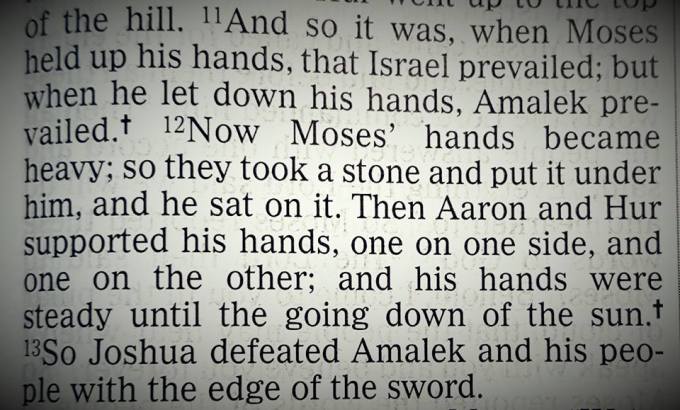
From Exodus chapter 17
Though in the flesh, Moses was still; in the spirit he was calling out to the Lord, engaging in Spiritual warfare. Our triumph in the Spiritual warfare can only be attained through stillness in prayer (a spiritual discipline called “Hesychia” Psalm 45:11 LXX) and through the sign of the cross.
exodus17

On Human Willpower

Romans 3:21-22

Here we find the beloved apostle making a powerful statement; for if they who had received the Law were unable to attain to the righteousness of God, not only were they unable to attain it, but they were more heavily burdened by the knowledge of the Law; then how would those who were not given the Law ever to be able to attain to, not only a similar, but greater righteousness? Not only to escape punishment, but to actually attain to the degree that Paul had declare the Jews unfit for? See, we have to remember all of the indictments that Paul had already leveled against the Jews at this point, because it was the Jews who were declaring that only they, the elect of the Lord, were fit for salvation, that only they could ever attain to the righteousness of God, because only this elect group were in the favor of the Lord.

We must also remember that the Jews to whom he is speaking at this point know nothing of the close of what we know as the “Old Testament.” Rather, to them, the Law and the Prophets spoke of a Messiah who had not yet come, they had no faith in Jesus as our Lord. Based on the teachings of Leviticus, they conceived that righteousness could be obtained through the Law, and that the Law could be kept through obedience (Leviticus 18:5). In their belief, it was enough to “will” themselves into obedience to the Law, and thus they could obtain righteousness in absentia of faith. They believed, as many do even today, that they can be “good enough people” to obtain to the kingdom, regardless of their faith in the Lord. Yet, obedience without faith can never lead unto the righteousness of God, particularly considering the Lord’s command to “love the Lord your God with all your heart, all your soul, and all your mind.” No, attempted obedience in absentia of faith is the equivalent of spiritual bribery, it’s a mystical “quid pro quo,” the equivalent of the prayer that each of us has prayed at least once in our lives, “God, please________ and I will ______.”

Yet, the biggest problem with that prayer is this; it doesn’t work. And it doesn’t work because God doesn’t work that way. It’s not a form of barter with the Lord. Will He reward us for the good things that we have done? Sure He will. Will He punish us for the wickedness that we commit? Of course He will. Yet, it will all be done on the basis of our obedience to Him based on our faith, not based on our heart’s desire to gain favor with Him. See, the biggest problem with that prayer, with that entire mindset, is that it creates a very “me” centered theology. It creates a theology where we attempt to seek divine favor using human willpower as collateral. And how reliable is human willpower? Go to a gym on January 3rd, and then return to that same gym on March 31st. You will see how reliable willpower is. Further, when we circumvent the necessity for faith in our faith, our prayer becomes very much centered on what I want, what I need, when I want what I want. Our prayers become, “Lord, please give me this, help me with this, help my brother with that, make the pain go away.” It becomes very pridefully us telling God how things need to be, or it becomes a very empty “Lord, please let Your will be done,” as though if we didn’t pray that, His will wouldn’t be done. When faith is present in our lives, true faith, then our prayers become worship, they become praying for the entire world, for the government (even if it isn’t the person we would’ve elected), they become praying for the poor and the homeless, for the needy, for the sick and suffering servants of the Lord. We become the last people that we pray for, and that usually for the wisdom and guidance to live a life that would glorify Him. It is no longer, “Lord, please heal my best friend’s cousin of his cancer,” but instead, “Lord, give me the wisdom to learn from these circumstances.”

See, Paul’s lesson here is that the Law will never be able to bring a man to righteousness in absentia of true faith. We can never “will” ourselves to righteousness. But, the inverse is possible. It is possible for those who have never received the Law to obtain to this righteousness through faith, because the Lord has written the Law on the hearts of all men (Hebrews 10:16), and those who have faith in Him will choose to obey that Law, not through their own willpower, but through seeking after the kingdom of God and His righteousness. Those who turn to Jesus in true faith are able to achieve this righteousness because Jesus Himself supercedes the Law, and the Holy Spirit will guide us to obedience to His Law.

And notice what Paul writes, not merely righteousness, but the “righteousness of God,” and not that it is given, but that it is revealed, that it is made manifest. The word here in the Greek is the word “phaneroo,” which literally translates “to make manifest or visible what is hidden.” This is of such importance to us considering the topic of this letter, because the Jews had taught that they alone were able to attain to righteousness and that the rest of mankind was wicked, and yet, Paul’s very wording here teaches us that this righteousness is not “given to us” through our faith, but rather that it is revealed to us through it. He is saying that this righteousness already exists within us all, but it is through our faith in Jesus that it is revealed to us, that our true nature is brought to light. We are not innately wicked, but rather we are innately good and righteous and have merely been led astray, led on the wrong path, by a world which stands opposed to all things righteous and holy. The world doesn’t hate Jesus because they don’t believe in Him, the world hates Jesus because He displays what they were created to be but choose not to be. And we, being born into the world and exposed to the world, adopt this “when in Rome” mentality and begin to slowly become more and more corrupted; so much so that it requires dying to ourselves to be freed from the bondage to sin that the world creates within us. The glory of God is eternal righteousness and eternal life. Our salvation is not merely entrance to the kingdom, it is also our ability to live while we are still here on the earth, free from bondage to sin. Our salvation, our Christian walk, is the ability to walk in this world free from the sickness of sin that plagues the world.

Our world is a sick world, and our Lord is the great Physician. Our sickness is not merely physical, but also spiritual. Our sickness is manifested in the temper that we can’t control, the lustful thoughts which haunt us, the greed which causes us to cheat and lie, the self-love that causes us to place our own comfort over someone else’s survival. And the Lord’s offer of salvation isn’t that we can continue to suffer through those ailments until the day that we fall asleep and then enter the kingdom, it is instead the offer of curing us of those sicknesses while we are still here. It is the cure to the sickness of sin. The Lord is the great Physician, and the Church, the one Church, is His hospital wherein He is able to heal us. Too many Sundays are spent in theaters, in lecture halls, in theology classrooms, in courtrooms; and not nearly enough are spent in the great halls of healing. Far too few believers on far too few Sundays spend their time in corporate prayer, in worshiping the One who alone is worthy; seeking after and praising the Physician who alone can heal our souls and bring us back into communion with Him.

My brothers and sisters, I ask you to consider this. Consider your Sunday services and ask this one question; what is the focal point of the service that you are in? Is it Jesus Christ glorified? Is the focal point a lecture? Is it a band playing? Is the focal point a lesson in theology and doctrine? Or is the focal point communion with the Lord? Each of those things is great, but if the focal point of Sunday worship isn’t worship, then is it truly the Church that we read about in the Book of Acts? We can listen to a band on our own, we can have small study groups for Bible studies. Outside of our service though, we can’t come together as one body in communion with the Lord. We can’t be involved in corporate prayer and worship alone. We can’t celebrate the Eucharist alone. Those other things are great, but those other things can be done outside of the Liturgy. When we look to Scripture, we see that even the Cherubim in the heavens fall down in corporate worship, singing the angelic hymn, “Holy holy holy, is the Lord of Hosts; the whole earth is full of His Glory.” (Isaiah 6:3). If the angelic hosts fall down and worship in this fashion, shouldn’t we honor Him in the same manner?

May the grace of the Lord be with you, my beloved family. Christ is risen!